miércoles, 20 de mayo de 2015

OTHER EXPLORERS

  
       VASCO NUÑEZ DE BALBOA


(Jerez de los Caballeros, Spain, 1475 - Acla, Panama Current, 1519) Spanish Discoverer. Galician origin and uncertain lineage, it was probably son Nuno Arias Balboa gentleman and a lady of Badajoz.
In 1501 he undertook 
      his first trip to the issuance of Rodrigo de Bastidas through the Caribbean islands that belong to the current Colombia In 1511, Balboa won the governorship; Moved by the desire to discover the sea speaking Indians, went into the continent and the September 25, 1513 ended one of the greatest feats of the Spanish conquest of America, the discovery of the South Sea, name given then the Pacific Ocean. After the arrival of Pedrarias Davila, the new governor, Balboa retained charges ahead of South Sea and governor of Panama and Coiba, and began exploring the Pacific coast. On hearing that his father was to be replaced, he returned to Acla to support it, but Pedrarias accused him of conspiring against the Crown, and the finder was tried, sentenced to death and executed in Acla.


       AMERIGO VESPUCCI


(Amerigo Vespucci, Florence, 1454 - Seville, 1512) Italian navigator whose name would cause the name of the American continent. As is known, Christopher Columbus died believing he had reached the Indies, without suspecting that those islands which had taken possession in the name of the Crown of Castile belonged to a new continent. A friend of his, Amerigo Vespucci, was asked to tell the old Europe that lands found by Columbus were not Asian, but part of a "fourth pars" the world that would give his name involuntarily. This man, insignificant compared to the great figure of Columbus, also died without knowing the effects of its revolutionary news: posthumous glory, derived from the casual baptism for himself and his lineage.
The name of America began to spread and flood everything. Earlier, in 1505, Amerigo Vespucci had become Amerigo Vespucci upon being granted naturalization in the kingdoms of Castile and Leon. His fame as a merchant seaman and had grown considerably, to the point of taking you to participate in the Board of Burgos next to sailors, explorers and cartographers as illustrious as Finch, Solis and Juan de la Cosa in 1507, and being named greater pilot House of Hiring the following year.

At his death in 1512, the New World had definitely become America.


     FERDINAND MAGELLAN


Ferdinand Magellan was born in Portugal, circa 1480. As a boy, he studied mapmaking and navigation. n 1505, when Ferdinand Magellan was in his mid-20s, he joined a Portuguese fleet that was sailing to East Africa. By 1509, he found himself at the Battle of Diu, in which the Portuguese destroyed Egyptian ships in the Arabian Sea. Two years later, he explored Malacca, located in present-day Malaysia, and participated in the conquest of Malacca's port. It was there that he acquired a native servant he named Enrique. It is possible that Magellan sailed as far as the Moluccas, islands in Indonesia, then called the Spice Islands. The Moluccas were the original source of some of the world's most valuable spices, including cloves and nutmeg. The conquest of spice-rich countries was, as a result, a source of much European competition.


    JUAN SEBASTIÁN ELCANO

Spanish navigator who completed the first circumnavigation of the world (Guetaria, Guipúzcoa, 1476 - Pacific Ocean, 1526). The first news we have of him show him as a Basque sailor with ample nautical knowledge, who participated in the expedition of Cisneros to Algiers (1509) and the Italian campaigns of the Great Capitán.En 1518 he met in Seville to the Portuguese navigator Magellan that preparing an expedition to the service of Spain to find the route to the Indies by sailing west. Elcano enlisted in the expedition, which departed from Sanlucar de Barrameda in 1519 and explored the Rio de la Plata and Patagonia; there Elcano helped quell a first riot, but participated in a second attempt against Magallanes, who spared his life, is not to consider him or find him guilty essential to continue the journey (1520).

With reduced to a secondary role Elcano, the expedition discovered the passage from the Atlantic to the Pacific through the South American continent and the Mariana Islands and the Philippines. When Magellan died in a battle with the natives of the Philippine island of Mactam (1521) the expedition was under the command successively several of his captains who vied for power, still exploring the islands, building relationships with local chiefs and earnestly seeking the route to the Moluccas.


lunes, 6 de abril de 2015

THE PRINTING PRESS

printing press is a device for evenly printing ink onto a print medium (substrate) such as paper or cloth. The device applies pressure to a print medium that rests on an inked surface made of movable type, thereby transferring the ink. Typically used for texts, the invention and spread of the printing press are widely regarded as among the most influential events in human history, revolutionizing the way people conceive and describe the world they live in, and ushering in the period of modernity.
The world's first movable type printing was invented and developed in China by the Han Chinese printer Bi Sheng between the years 1041 and 1048. His contemporary Shen Kuo wrote extensively about the movable type printing technology developed by Bi Sheng in his scientific book, the Dream Pool Essays, which was published in 1088. This technology was transmitted to Korea during the Goryeo Dynasty, where the Korean inventors subsequently made many new technological improvements and innovations upon the original technology and in 1234 created the world's first metal movable-type printing technology for printing paper books 216 years before Gutenberg's printing press. This led to the printing of a Korean book, using the ancient Chinese writing system, known in Korean as the Jikji in 1377; it is the oldest extant movable metal printed book. This form of metal movable type technology has been described by the French scholar Henri-Jean Martin as similar to Gutenberg's.

jueves, 19 de febrero de 2015

MEDIEVAL INSTITUTIONS IN SPAIN

The institutionalization of the feudal monarchy included the creation of the Courts, extension of the Curia Regis to set up a representative assembly of the nobility, clergy, and the cities of each realm. The alternatives of dynastic politics determined inheritances and marriages that divided and merged kingdoms (Castilla y León repeatedly until final unification with Fernando III "the Saint"). Faced with greater inner power that managed to accumulate the kings of the Crown of Castile, opposite case was that of Aragon turned into kingdom after its separation from Navarra, the military orders of the testament of Alfonso been met could have become a territory by I Fighting; nobles agreed to ignore it, and raise the throne Ramiro II the Monk (the legendary bell Huesca) who, a year to ensure the succession to the birth of his daughter Petronila, agreed to her marriage to the Count of Barcelona Ramon Berenguer IV , who left the government of the kingdom, returning to his monastery (in 1137 -the wedding had to wait thirteen years). The resulting political entity (Crown of Aragon) was incorporating the successive conquests of such separation criteria: federal territories with different institutions.


jueves, 8 de enero de 2015

THE HUNDRED YEARS WAR

The Hundred Years War was a series of wars between England and France. The background of the Hundred Years War went as far back as to the reign of William the Conqueror. When William the Conqueror became king in 1066 after his victory at the Battle of Hastings, he united England with Normandy in France. William ruled both as his own.
Under Henry II, the lands owned by England in France became even larger and the kings who followed Henry found the land they owned in France too large and difficult to control. By 1327, when Edward III became king, England only controlled two areas of France - Gascony in the south and Ponthieu in the north.
In 1328, Charles IV of France died. Charles did not have any sons to take over his land and all his brothers were dead. He did have a sister called Isabella. She was the mother of Edward III and Edward believed that because of this, he should be king of France. However, the French decided that a cousin of Charles, Philip, should be crowned king.
Edward was furious but he was not in a position to do anything in the late 1320’s. By 1337 he was ready to fight for what he believed was his and he declared war on Philip. Edward was not only willing to fight for what he believed was his - the crown of France - but also he feared that Philip was a threat to his possessions in France - Gascony and Ponthieu.
Edward now had to raise an army. There were men who looked forward to fighting abroad in an army as it gave them the opportunity to plunder treasure and bring things back to England which could make them rich. However, many men were not keen on fighting as they were usually more concerned about farming. A war in the autumn could be a disaster as this was harvest time.
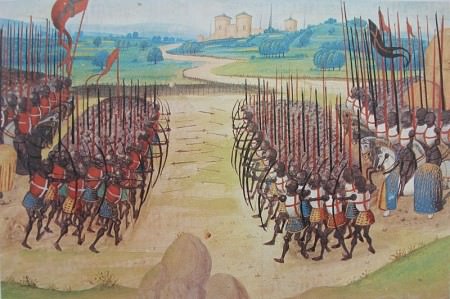
The feudal system meant that knights had to provide the king with soldiers when the king demanded them. However, war had moved on from the time of the Battle of Hastings and the longbow was now the most feared of weapons and not the knight on horseback. The king's officials went around England looking for skilled archers. All young men in medieval villages were expected to practice archery so there were many skilled archers to be found. It was left to a village to decide who would actually go to fight but the village as a whole would have to look after the family or families affected by someone leaving. Those who went were paid three pence a day.
Armies were very expensive. Fighting abroad made them even more expensive to run. This problem could be got around by making a local area in France, which was under your control, pay a 'tribune' to you. This would keep your costs down. In return for paying a tribune, the area concerned was given a promise that the troops there would behave themselves and would not damage homes, steal crops and kill animals. In this sense, paying a tribune was similar to buying protection.